Pokémon Collection Value: How to Calculate and Track It
How to work out what your Pokémon collection is worth: match each card exactly, use the right price, handle graded and sealed items, and keep the total current.
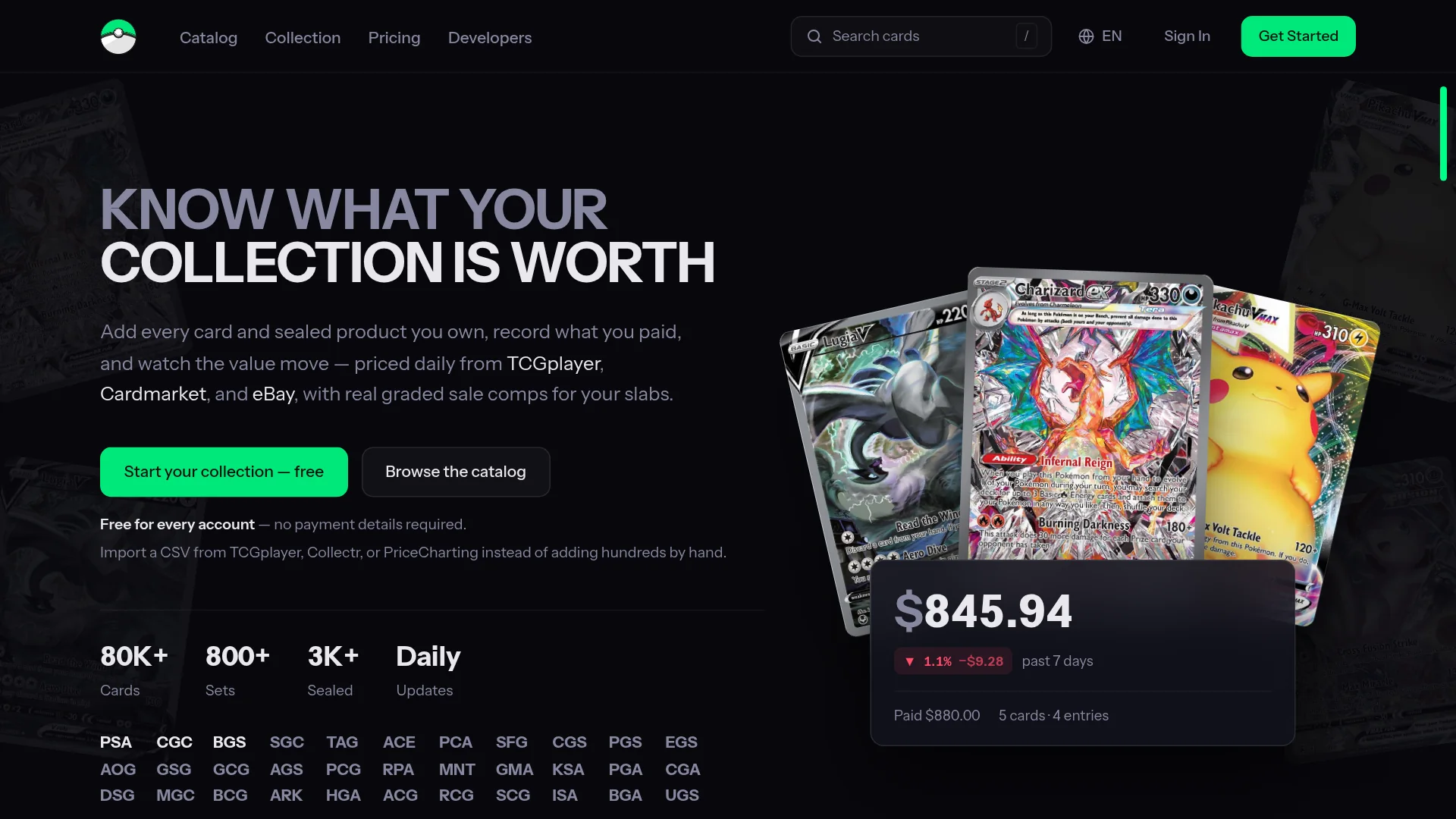
A Pokémon collection's value is the sum of what each card and sealed product would sell for today, in its own condition, variant and grade. Adding up the prices from the first search results gets you a different, wrong number. The reliable method is to identify every item exactly, price it from recent market data for its condition and grade, and re-run the total on a schedule. We built PkmnPrices around that method: prices from TCGplayer, Cardmarket and eBay updated daily, a free collection value tracker, and an API for developers who want the same data in their own app.
This guide covers the method for collectors and for developers building valuation features. It explains what moves a card's price, how to price a single card, how to scale that to a collection, and how to keep the total current.
The short version
- Collection value is the sum of market price × quantity for each item, where the price matches the exact card, printing, condition and grade.
- Use sold prices and market averages, not asking prices. Check more than one marketplace, because TCGplayer (US dollars) and Cardmarket (euros) price the same card differently.
- Graded cards are priced by grading company and grade, not as raw cards. Sealed product is priced separately from singles.
- Values change daily. Record a dated snapshot of your total each month so you can see the trend.
- Our free tracker supports CSV import and export. Developers can pull the same data through the API, with SDKs for JavaScript and Python.
What determines a collection's value
Two cards with the same name can sell for very different prices. Before any math, you need to know which factors matter.
Card identity and printing
A card is identified by its set, its number within the set and its variant. "Pikachu" is not a price point. The Pikachu #01 WoTC promo, the Pikachu secret rare #241 from Cosmic Eclipse and the Pikachu V #TG16 from the Lost Origin Trainer Gallery are three different products with three different markets. Holofoil, reverse holofoil, first edition and promo stamps each create a separate price line for the same card number.
Many valuation mistakes start here. If you match a card by name alone, you get the price of whichever printing the search returns first.
Condition
Raw (ungraded) cards are priced by condition: Near Mint, Lightly Played, Moderately Played, and so on. A Near Mint price applied to a card with whitening on the edges overstates its value. The gap between conditions is small on bulk cards and large on valuable ones, so the more a card is worth, the more carefully you should judge it.
When you grade condition yourself, check under a bright light for edge whitening, surface scratches, corner wear and print lines. Be conservative. Marketplace buyers grade strictly, and a card you call Near Mint can come back as Lightly Played.

Grading
Grading adds a second layer. PSA separates authentication, which verifies that a card is genuine, from grading, which scores its condition on a 10-point scale. Once a card sits in a graded slab, its price depends on the grading company and the grade, and the difference between a 9 and a 10 can be large.
The same PSA page states that 90% of modern trading card game cards (2003 to present) have graded PSA 8 or higher, and 80% of vintage cards (before 2003) have graded PSA 7 or higher. High grades are common for modern cards, so the premium for a top grade depends heavily on how many copies reach it. That count is the population report. Our guide to reading a Pokémon card's population report explains how to use it, and our comparison of PSA, BGS and CGC shows how the market prices each company's slabs.
Authenticity and alterations
A market price only applies to an untouched card. Authentication includes checking for tampering, such as coloring over white specks or trimming edges to hide wear. An altered card is not worth the price of an unaltered copy. If a high-value card in your collection came from a private sale, confirm it is genuine before you count it at full price.
Rarity and demand
The rarity symbol printed on a card does not reliably tell you how many copies exist. Price follows demand for the character and the artwork, playability, and how many copies were printed and survive. Treat rarity as a hint about where to look, and let sale prices decide the value.
Which price to use
Marketplaces show several numbers for each card, and they mean different things.
| Price type | What it tells you | Use it for |
|---|---|---|
| Lowest listing | The cheapest current asking price | A floor, not a value |
| Market price or trend | A figure derived from completed sales over a recent window | The default unit price for raw cards |
| Recent sold comps | Individual sales, with date and condition or grade | Graded cards and high-value singles |
| Asking price on a single listing | What one seller hopes to get | Nothing for valuation |
For raw cards, use a market price built from completed sales. For graded cards and anything expensive, look at individual sold comps for the same grade, because a single average can hide a wide spread.
Different marketplaces, different numbers
TCGplayer is a US marketplace priced in dollars. Cardmarket is a European marketplace priced in euros, and its listings and sales mix languages and conditions that you need to filter. eBay shows individual auction and fixed-price results, including graded sales. The same card lands at a different value on each, because the buyers, shipping costs and language mix differ. Pick the marketplace where you would actually sell, and use it for the whole collection. If you mix sources card by card, your total will move for reasons that have nothing to do with the market.

Selling costs matter if you want to know what you would take home rather than what the cards are "worth". For example, eBay.ca charges a 13.25% final value fee on the total sale amount up to $7,500, plus a per-order fee, in Canadian dollars. Fee schedules differ by country, so check the fee page for the country you sell in before you subtract anything from your total.
How to value a collection step by step
1. Inventory every item with exact identifiers
List each item with set, card number, variant (holo, reverse, first edition), condition or grade, and quantity. Sealed products get their own rows: booster boxes, Elite Trainer Boxes, cases. The XY Evolutions booster box case is a typical sealed line item, priced separately from the cards inside it.
The usual mistakes are matching by name, skipping the number, or ignoring a reverse holo stamp. Set card lists with numbers help. Our pages for sets such as Pokémon GO and Ruby and Sapphire list every card with its price, so you can match the number printed on the card.
Our tracker handles this step with the catalog: every card has its rarity and image, so you pick the card by sight instead of retyping identifiers from memory.
2. Assign a condition or grade
Use one scale for the whole collection. Raw cards get a condition. Slabbed cards get a company and grade. Where a card is worth enough to matter, photograph it under good light and be honest about the edges.
Our data prices cards per condition, variant and grade, and includes graded sale comps and population counts, so a PSA 10 is never priced as a Near Mint raw copy.
3. Pull a market price for each line
Take the market price for the exact card, variant and condition from your chosen marketplace. For graded cards, use recent sold comps for the same company and grade. Record the date you pulled each price.
The usual mistakes here are using the lowest listing (too low), relying on one outlier sale (too high or too low), and mixing currencies without noting the conversion date.
We update prices daily from TCGplayer, Cardmarket and eBay, and keep price history per grade and variant, so you can see whether today's price is typical or a spike.
4. Multiply and sum
For each row, multiply the unit price by the quantity. Then add the rows.
Here is the arithmetic with made-up figures:
| Item | Condition or grade | Qty | Unit price | Line value |
|---|---|---|---|---|
| Holo rare single | Near Mint | 1 | $12.00 | $12.00 |
| Reverse holo uncommon | Lightly Played | 4 | $0.75 | $3.00 |
| Modern chase single | PSA 10 | 1 | $85.00 | $85.00 |
| Booster box, sealed | Sealed | 1 | $140.00 | $140.00 |
| Total | $240.00 |
The one sealed box and the one graded card make up most of the total. In real collections a handful of lines usually carry most of the value, so those are the lines to check most carefully.
5. Separate bulk from valuable cards
Thousands of commons and uncommons often add up to very little per card. Count them by weight or by quantity at a flat bulk rate, and spend your time on the cards above a threshold you choose, such as $5. That keeps the inventory manageable without distorting the total.
6. Save a dated snapshot
A collection value only means something with a date. Save the total, the date and the marketplace you used. Next month, repeat the process and compare. The change between two snapshots tells you how the market is treating your collection.
Trackers, spreadsheets and CSV
Many collectors start with a spreadsheet: one row per card, a price column and a SUM formula. It works for a few dozen cards. As the collection grows, every price has to be looked up and typed by hand, and the numbers go stale the day after you enter them.
A collection tracker removes the lookup. You select the card, set the condition and quantity, and the tracker applies the current price and totals the collection. Our collection value tracker is free and supports CSV import and export, so you can bring an existing spreadsheet in or take your data out for your own analysis. If your spreadsheet already has set, number, condition and quantity columns, the import saves you from re-entering the collection.
For clean matching, the CSV should include set name, card number, variant, condition or grade, and quantity. The card number and variant are the columns that prevent mismatches.
Keeping the value current
Prices move with new set releases, tournament results, reprints and attention on a character or card. A few habits keep your number meaningful:
- Re-price on a schedule. Monthly is enough for most collections; check expensive cards more often.
- Log changes the same day you add a card, sell one or send one off for grading. A graded card changes lines: the raw price no longer applies once it is slabbed.
- Watch sealed product separately. Sealed prices follow print runs and availability more than singles do. Our guide to Pokémon pack prices, MSRP and market value shows how to track them.
- Read the wider market. Our Pokémon card market reports show broader trends, which helps you tell a market-wide move from a change in one card.
For developers: collection valuation through an API
If you are building a collection app, a storefront, a Discord bot or a portfolio dashboard, the same method becomes a few API calls: resolve each item to a unique card or sealed product, fetch the price for its condition, variant or grade, multiply by quantity and sum. What you need on top is reliable identifiers, current prices and fast responses.
Our API is written in Rust for sub-100ms responses. It returns daily pricing from TCGplayer, Cardmarket and eBay for individual cards and sealed products, along with rarity, images, graded population counts and price history per grade and variant. We provide SDKs for JavaScript and Python. Our Pokémon TCG API comparison covers the other options, and you can check service status at any time.
A few design points for a valuation feature:
- Store identifiers, not names. Save the card ID with the user's condition and quantity, and fetch prices at read time.
- Cache by day. Prices update daily, so caching a card's price for the day cuts calls without losing accuracy.
- Keep the currency explicit. TCGplayer figures are in dollars and Cardmarket in euros, so store the currency with every value.
- Keep snapshots. Save each user's total with a date, so charts do not depend on recomputing history.
Pricing
The collection tracker is free, and the API has a free plan at $0 per month. Paid plans are Collector at $5.99 per month, Pro at $14.99, Scale at $39.99 and Business at $89.99. API usage is credit-based. The pricing page compares the plans, and the free plan is enough to value your first collection or make your first API call.
Frequently asked questions
- How much is my Pokémon card collection worth?
- It is the sum of each item's market price at its exact condition or grade, multiplied by quantity. Identify every card by set, number and variant, price it from recent completed sales, and add the lines. A few high-value cards and sealed products usually make up most of the total.
- Is there a free Pokémon card collection tracker?
- Yes. Our collection value tracker is free, applies current prices to the cards you add, and supports CSV import and export, so you can bring in an existing list. It prices cards by condition, variant and grade.
- Can I use a spreadsheet to track collection value?
- Yes, with columns for set, card number, variant, condition, quantity and price. The weak point is the price column, which you update by hand and which goes stale quickly. Importing the spreadsheet into the tracker as a CSV gives it current prices automatically.
- Why do prices differ between TCGplayer, Cardmarket and eBay?
- Each marketplace has its own buyers, currency, shipping costs and mix of languages and conditions, so the same card sells at different prices. Pick the marketplace you would sell on and use it for the whole collection.
- Is there an API for Pokémon collection valuation?
- Yes. Our API returns daily prices for cards and sealed products, with rarity, images, graded population counts and price history per grade and variant. You resolve each item to an ID, fetch its price and sum the results. SDKs are available for JavaScript and Python.
Sources

Written by
PkmnPrices
PkmnPrices is a developer API for Pokémon TCG data: daily TCGPlayer pricing across 80,000+ cards, 800+ sets, and sealed products.