Pokémon Pack Prices: MSRP, Market Value and How to Track Them
What a Pokémon booster pack costs: the $4.49 US list price, why market prices differ, how to read sold prices, and how to track pack prices by API.
A standard Pokémon TCG booster pack has a US list price (MSRP) of $4.49 as of September 2026, but the price you actually pay or can sell at is set by the market for that set, that product and that week. To price packs reliably you need the MSRP as a baseline, a market price built from real sales, and a source that refreshes daily. PkmnPrices supplies that data for sealed and individual cards through one API, and its free tier lets you start without paying.
The short version
- The US MSRP for one standard booster pack is $4.49 (September 2026). Boxes and bundles are generally priced to the same per-pack rate at list.
- Market price is not MSRP. It reflects what packs actually sell for, and it moves with set age, demand and availability.
- Compare products by price per pack: divide the total price by the number of packs, and expect an Elite Trainer Box to cost more per pack because of its extras.
- A price far below list is a warning sign for fake or tampered product.
- To track pack prices over time, pull daily data from TCGplayer, Cardmarket and eBay through the PkmnPrices API, or use the free collection value tracker.
What a Pokémon booster pack is
A booster pack is a sealed foil pouch of randomized cards from one expansion. According to The Pokémon Company's own support page, an official pack holds 10 cards: 4 commons, 3 uncommons and 3 foil or rarer cards. The same page notes that the company guarantees that structure but does not publish rarity pull rates for boxes.

That last point matters for pricing. Every pack is a lottery ticket with a fixed structure and an unpublished payout, so the market, not the publisher, decides what a pack of a given set is worth.
MSRP: the baseline price for a pack
MSRP is the manufacturer's suggested retail price, the number the publisher sets and retailers are meant to anchor to. In the US, DexCompare lists a single standard booster pack at $4.49 as of September 2026. Prices of this kind are revised by the publisher from time to time, so treat the figure as a dated reference and not a permanent constant.
Three practical consequences follow.
- MSRP is a floor for new, in-stock product at a fair retailer, not a ceiling. Stores often charge more when demand is high, and many shelves price above list for hot sets.
- Boxes and bundles use the same logic. A 36-pack booster box and a 6-pack booster bundle are generally listed at the same per-pack rate, so the box price is roughly 36 times the pack price at MSRP.
- Region changes everything. The $4.49 figure is a US number. Cardmarket prices in euros and sellers in other countries price against different list prices and taxes, so do not compare across regions without converting and noting the date.
Why market price differs from MSRP
Market price is the going rate across public marketplace listings and sales. One market tool defines it as the price observed across public US listings and sales, refreshed nightly, in contrast to MSRP, which is the publisher-set price. The two numbers answer different questions: MSRP tells you what the product was meant to cost, market price tells you what it costs to buy or sell now.
What moves a pack's market price:
- Set age and print run. Current sets usually trade near list or modestly above it while they are widely printed. Out-of-print sets tend to rise as supply dries up and nostalgia builds, a pattern shop price guides describe.
- The cards inside. A set with a chase card that is worth hundreds of dollars lifts the value of every sealed pack, because buyers are paying for the chance to pull it.
- Product format. Single packs, blister packs, bundles, Elite Trainer Boxes and booster boxes each carry a different price per pack.
- Language and region. Japanese, English and other language packs trade as separate markets.
- Availability. Allocation shortages, restocks and reprints can change a price within days.
Pack price versus the value of the cards inside
A pack's price is a bet on what is inside. The expected value of a pack is the sum of each possible card's price weighted by how often it appears. Rare pulls are rare: a published tally of one recent set's rates puts Double Rares at about 1 in 5 packs and Mega Hyper Rares at about 1 in 1,786 packs. Those are community-compiled estimates and not figures from the publisher, who does not release them, so use them as orders of magnitude.
This is why a sealed pack can trade above or below the sum of its typical contents. Sealed price reflects expectation and scarcity. Opened-card prices reflect each single card's own supply and demand. To compare the two you need both sides in one dataset: sealed product prices and per-card prices for the same set, ideally split by variant and condition.
A worked example: price per pack
Suppose a store lists an Elite Trainer Box for $55 that contains 9 packs, a booster bundle for $26.94 with 6 packs, and a booster box for $161.64 with 36 packs.
| Product | Price | Packs | Price per pack |
|---|---|---|---|
| Elite Trainer Box | $55.00 | 9 | $6.11 |
| Booster bundle | $26.94 | 6 | $4.49 |
| Booster box | $161.64 | 36 | $4.49 |
These prices are illustrative, not a quote. The method is the point: divide the price by the pack count. An ETB costs more per pack because it includes a promo card and accessories, so judge it on the whole contents and not on packs alone. Also check the pack count for the specific set, because contents differ between product lines.
How to tell whether a pack price is reliable
Not every number you see is a price anyone paid. Work through these checks before you trust or publish a figure.
- Prefer sold prices to asking prices. An asking price is a seller's hope. A market price built from completed sales shows what buyers accepted. TCGplayer's market price and sold listings reflect real sales, while a single high listing tells you little.
- Check the date. A price from last month for a freshly released set is stale. New-release prices can swing sharply in the first weeks, then settle.
- Check the product and language. A Japanese pack, a display box and a single English pack are not interchangeable.
- Be suspicious of prices far below list. A pack priced dramatically under suggested retail is a strong signal of fakes or resealed product, according to guidance relayed from Pokémon Support. If the number looks too good, the product probably is not what it claims.
- Use more than one source. US marketplaces, European marketplaces and auction sales can disagree. Seeing TCGplayer, Cardmarket and eBay side by side tells you whether a price is an outlier.
Tracking pack prices over time
A single price is a snapshot. A trend is more useful: it tells you whether a set is still climbing, has peaked or is being reprinted. There are a few things to look at.
- Dollar-volume rankings. TCGplayer's sealed product chart ranks its most active sealed products by dollar volume and shows beginning and ending prices, as ICv2 reported for April 2025. It is a good example of how to read price change against sales volume.
- Long-run vintage trends. Sealed vintage product has seen explosive growth. Reporting on 1st Edition Base Set booster boxes describes prices rising from mid-five figures in 2017 to verified sales of $408,000 by January 2021. At that level condition, provenance and third-party authentication drive the number.
- Your own history. If you run a store, app or collection, store a price snapshot every day so you can chart changes per product yourself.
The third approach is where most developers and businesses end up, and it is where the data source decides the quality of everything built on it.
What each reader needs from pack price data
Collectors want to know what their sealed product is worth and whether a set is rising. A per-set view of sealed and single-card prices answers this. You can browse every Pokémon TCG set with card lists and prices, including older releases such as Team Rocket Returns and Ruby and Sapphire.
Gamers and market watchers want trends: which sets are heating up and which are cooling. That needs history, not a snapshot.
Developers and businesses want a feed they can query, cache and display without scraping. That means consistent identifiers, complete card data, a stable schema and fast responses.

Getting pack and card prices through an API
Scraping marketplaces for pack prices is brittle: layouts change, rate limits bite and each site names products differently. An API with a stable schema replaces that work with a single request pattern.
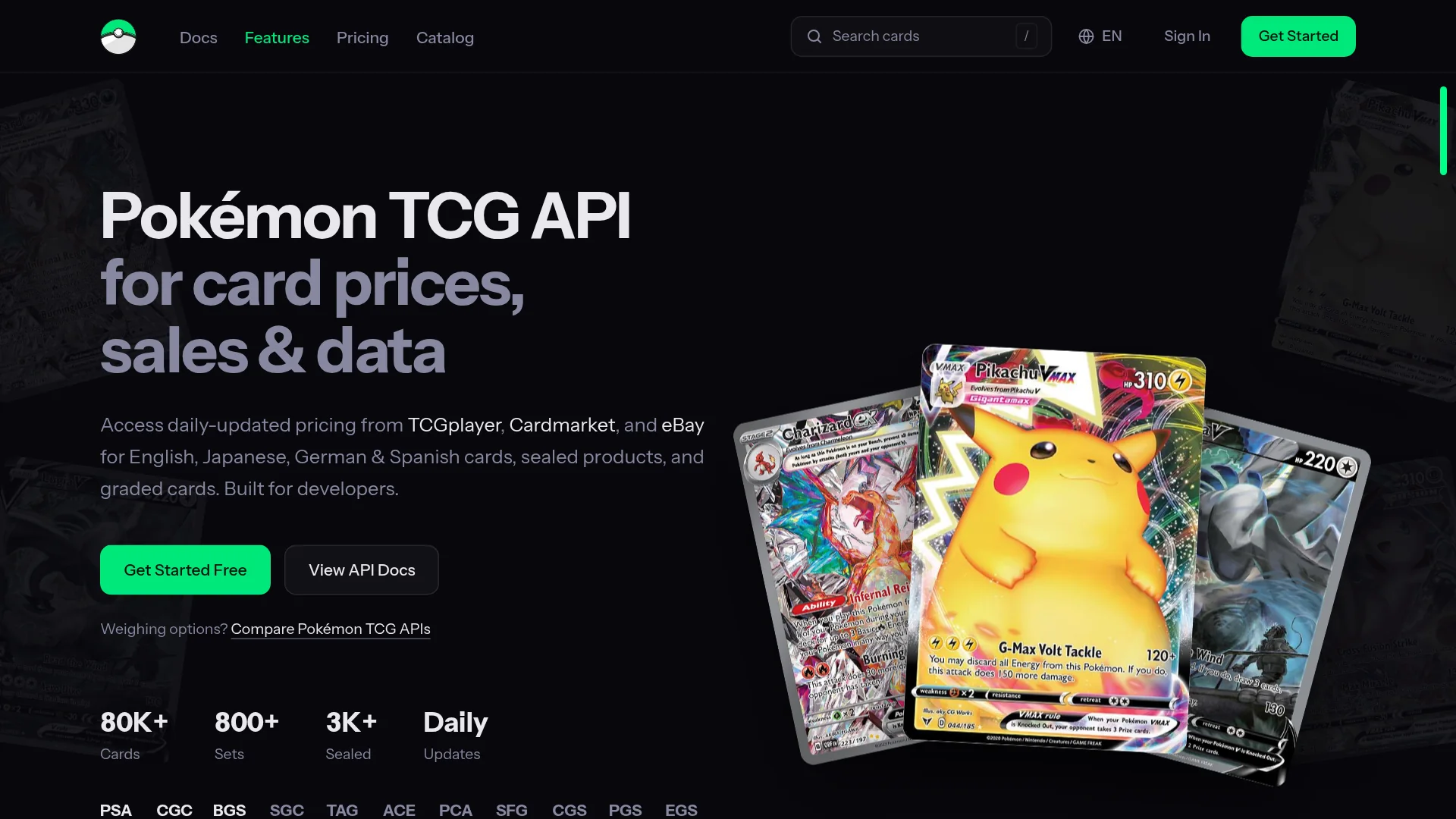
PkmnPrices is built for this. It provides real-time Pokémon TCG price data for individual cards and sealed products, with daily updates from TCGplayer, Cardmarket and eBay. Each card record includes rarity and images, along with graded population counts. Price history is tracked per grade and variant, so you can chart a card's raw and graded trend separately. The API is written in Rust and is designed for response times under 100 ms, and SDKs are available for JavaScript and Python.
Here is how the API maps to the checks above:
| Reliability check | What you need | What PkmnPrices provides |
|---|---|---|
| Multiple sources | Prices from more than one marketplace | Daily updates from TCGplayer, Cardmarket and eBay |
| Trend, not snapshot | History you can chart | Price history per grade and variant |
| Sealed versus singles | Both in one dataset | Pricing for sealed products and individual cards |
| Graded value | Real graded comps | Graded sale comps and population counts |
| Easy integration | Typed clients | SDKs for JavaScript and Python |
If you are weighing different kinds of price API, the comparison of Pokémon TCG APIs walks through coverage and pricing models. If you already use an older card-data API, the guide to migrating from pokemontcg.io covers the move. For building quickly, there is a guide to using the PkmnPrices API with Claude Code, Cursor and Codex. You can check service health on the status page.
Start with real pack prices
PkmnPrices has a Free plan at $0 per month, plus Collector, Pro, Scale and Business plans for higher usage, all listed on the pricing page. Usage is credit-based, so you can start small and move up as your app or store grows. Collectors who do not need the API can use the free collection value tracker, with CSV import and export for existing collections.
A sensible first project: pick three sets you care about, pull sealed and single-card prices daily, and store them. After a few weeks you have your own trend chart, built on prices from several marketplaces and not from one listing.
A short routine for pricing any pack
- Note the product type, set, language and pack count.
- Compute price per pack and compare it with the $4.49 US MSRP baseline.
- Look up the market price from sold data, not asking prices.
- Cross-check at least two marketplaces.
- Record the date and the source with the number.
- Repeat on a schedule, and compare against the previous reading.
Step 5 is the one most people skip. A price without a date and a source cannot be compared later, and a trend is only a series of dated readings.
Frequently asked questions
- What is the MSRP of a Pokémon pack?
- The US MSRP for a standard booster pack is $4.49 as of September 2026. Booster boxes and bundles are generally priced to the same per-pack rate at list. Retailers may charge more, and the publisher can change list prices, so check the date on any figure.
- Why are booster pack prices higher than MSRP?
- Market price reflects demand and availability, not the publisher's list. Popular sets, short supply and valuable chase cards push prices above MSRP, while out-of-print sets tend to rise as scarcity and nostalgia grow.
- How do I find the value of a booster pack?
- Start with the price per pack for the product, then look at the market price built from sold listings for that exact set and language. Compare two or more marketplaces and note the date. The PkmnPrices set pages show card lists and prices per set, and the API returns sealed prices from TCGplayer, Cardmarket and eBay.
- How can I track Pokémon pack prices automatically?
- Use a price API that updates daily and stores history, then request the products you care about on a schedule. PkmnPrices tracks price history per grade and variant and offers JavaScript and Python SDKs, with a Free plan to begin.
Sources
- Pokémon TCG MSRP: US list prices for sealed product (DexCompare)
- What can I expect in a Pokémon Trading Card Game Booster Pack (Pokémon Center Support)
- How to use Market Insights (TCGGuy)
- How much do Pokémon booster packs cost: price guide (TCGShops)
- Perfect Order pull rates (Deltia's Gaming)
- How Many Packs in a Pokémon Booster Box (Iconic)
- TCGplayer Top 25 Sealed Product Chart, April 2025 (ICv2)
- Base Set Booster Box sale (Pokemon Pricing)

Written by
PkmnPrices
PkmnPrices is a developer API for Pokémon TCG data: daily TCGPlayer pricing across 80,000+ cards, 800+ sets, and sealed products.