Bulk Card Pricing Data: How to Fetch and Use It
What Pokémon bulk buylist rates mean, why they are not card values, and how to fetch daily prices for thousands of cards through an API and keep them accurate.
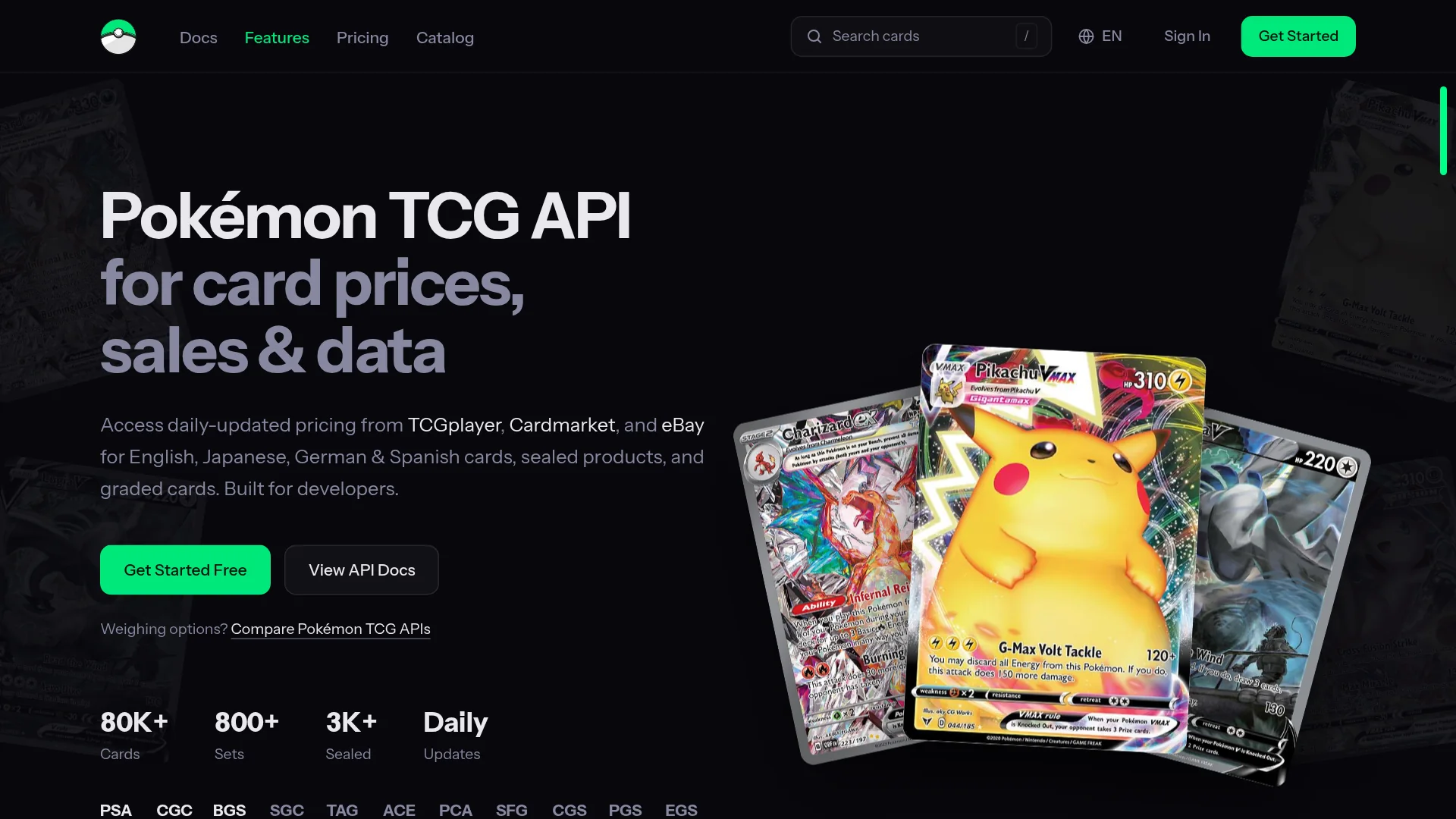
"Bulk card pricing data" means two different things, and the right answer depends on which one you need. If you want to know what a pile of commons is worth, you need buylist rates per 1,000 cards. If you are building an app, a dashboard or a valuation script, you need structured price data for thousands of individual cards and sealed products, refreshed on a schedule. This guide covers both. For the second case it shows what PkmnPrices provides: Pokémon TCG prices from TCGplayer, Cardmarket and eBay, updated daily, with rarity, images, graded population counts and price history, through an API with JavaScript and Python SDKs.
The short version
- Bulk buylist rates are set per category, not per card. At the buyer in the table below, commons and uncommons pay $0.02 each, while EX, V and GX cards pay $0.50.
- Published bulk prices are what a buyer pays you for sorted piles. They are not market values, so do not use them to value individual cards.
- To fetch prices for many cards, pull structured data keyed by card, variant, condition and grade, and store the source and timestamp with every price.
- PkmnPrices provides daily Pokémon TCG prices from TCGplayer, Cardmarket and eBay through an API, with a free plan to start.
- A collection is valued by joining your card list to price data. CSV import and export make that step repeatable.
Two meanings of bulk pricing data
Search results for this topic mix two kinds of pages. The first are buylist pages and forum threads that answer "what will someone pay me for 1,000 commons?" The second are data feeds that answer "what is this card worth today, and how do I get that number into my code?"
The two are related but not interchangeable. A buylist rate is a price a buyer sets for a category of cards so they can process volume. A market price comes from sales or listings of one specific card. Mixing them up is a common error in collection valuation: a spreadsheet that multiplies card count by a buylist rate understates every valuable card, and a spreadsheet that applies market prices to a mixed box of commons overstates the box.
This guide starts with what bulk rates represent, because collectors and sellers need that context. It then moves to fetching data programmatically, which is where developers and businesses spend their time.

What counts as bulk, and why one pile is not one price
Bulk means cards sold together in quantity instead of priced and listed one by one: usually commons, uncommons, rares, duplicates and holos. That does not mean every card in the pile has the same value. Holos, EX, V and Illustration Rare cards usually get their own rates.
Sorting changes the outcome a lot. A sorting guide published in August 2026 calls it the difference between two cents a card and two dollars a card on the same buylist. A full-art Trainer left in a pile of commons is paid at the 2 cent common rate; sorted into its own category, it earns 75 cents.
For anyone building a pricing tool, this means a card's category (rarity, card type, variant) is a data field with a direct effect on its value. Prices without those fields cannot be interpreted.

What published bulk rates look like
The figures below are published buylist rates, meaning what a buyer offers you. They are dated snapshots and change as buyers adjust them, so treat them as ranges, not constants.
| Category | Meta TCG (per card) | Range across shops (US cash) |
|---|---|---|
| Common / uncommon | $0.02 | $10 to $30 per 1,000 sorted; $5 to $10 unsorted |
| Non-holo rare | $0.02 | $10 to $50 per 1,000 |
| Holo / reverse holo | $0.035 | $20 to $60 per 1,000 |
| EX / V / GX | $0.50 | $0.25 to $0.75 per card |
| VMAX / VSTAR | $0.75 | $0.35 to $1.50 per card |
| Illustration Rare | $0.25 | $0.05 to $1.00 per card (with Trainer Gallery) |
The first column comes from one buyer's own buylist page. The range column comes from a tier table read on October 30, 2026, which collects rates from several shops and also lists gold, rainbow and secret rares at 50 cents to $5.00 a card.
At the Meta TCG rates, 1,000 commons and uncommons come to $20, 500 holo rares to $17.50, and 100 EX cards to $50. The sorting guide describes a different model for the top end: Trainer Gallery, Illustration Rare and rainbow ultra rares bought at 80% of the TCGplayer market value, with a floor of $1 to $2 a card. That is where bulk pricing stops and individual card pricing starts, and it is why a data feed matters.
Why these rates are not card values
A buylist rate includes the buyer's labor, shipping, risk and margin. It is the price for selling quickly in volume. The market value of a card is a different number, drawn from what that card sells for on a marketplace. If you hold cards that clear $1 or more individually, price them individually. That is a data problem, and it is what the rest of this guide covers.
How to fetch Pokémon card prices in bulk
Pricing a few hundred cards by hand does not scale, and scraping marketplace pages breaks when the layout changes. The reliable approach is a price API with a stable card identifier, in five steps.
1. Decide what you are pricing
List the product types you need: singles, sealed products (booster boxes, Elite Trainer Boxes, packs), graded cards, or all of them. Each has its own price series. PkmnPrices covers individual cards and sealed Pokémon TCG products, so one integration handles both. For sealed pricing specifically, see our guide to Pokémon pack prices, MSRP and market value.
2. Key every card by a stable identifier
Card names are not unique. The same Pikachu appears in many sets, with different numbers, promos and variants. Match on set and card number or on the provider's card ID, never on the name alone. Our catalog gives each card its own page and ID, such as Pikachu (Secret) #241 from Cosmic Eclipse and Hoopa GX (Full Art) #166 from Team Up. Two cards that share a name differ by set and number, and they carry different prices.
A reliable pipeline therefore has a mapping table from your own records (collection rows, inventory SKUs, scanned cards) to the provider's card ID. Build that mapping once, validate it, and store it.
3. Request the fields you need, not just a price
A single number per card is rarely enough. For valuation and trend work, these are the fields that matter:
| Field | Why it matters |
|---|---|
| Source (TCGplayer, Cardmarket, eBay) | Each marketplace has its own currency, fees and buyers |
| Variant (holo, reverse holo, 1st edition and so on) | The same card number can have several prices |
| Condition | Near Mint and Damaged prices differ widely |
| Grade | Graded copies trade separately from raw cards |
| Rarity and images | Needed to display and categorize results |
| Graded population counts | Scarcity context for graded cards |
| Price history | Needed for trends and for checking whether a price is an outlier |
| Timestamp | Tells you how old the price is |
PkmnPrices returns daily prices per condition, variant and grade, plus card data including rarity and images. It also returns graded population counts, graded sale comps and price history per grade and variant.
4. Page through the catalog and cache the results
Fetching in bulk means paging through a set or the catalog, not calling the API once per card on every page view. Prices refresh daily, so pull the data on a daily schedule, store it in your own database, and serve your users from that store. That keeps your request volume predictable. PkmnPrices bills API usage in credits, so a daily batch that caches its results is also the cheapest way to run.
We provide SDKs for JavaScript and Python, so you do not have to write the HTTP layer, authentication or pagination yourself. If you want to compare providers before you choose, our comparison of Pokémon TCG APIs lays out the differences.
5. Validate before you trust
Before a price reaches users, run a few simple checks:
- Reject null or zero prices instead of storing them.
- Flag any card whose price moved more than a set percentage in a day, and check it against the history.
- Keep the source and timestamp next to the price so a stale value can be spotted.
- Log unmatched cards from your mapping step and review them instead of dropping them.
Why prices differ across sources, variants and regions
The same card can show three different prices on three marketplaces, and all three can be correct. The differences come from definitions.
On TCGplayer, TCG Market Price is the average price of recent sales through TCGplayer for a specific product in a specific condition. That is a different measure from the lowest live listing or the last sold price, which TCGplayer tracks separately. A tool that says "price" without saying which of these it means is leaving out the detail you need.
Other sources add further differences:
- Region and currency: Cardmarket is a European marketplace priced in euros, and TCGplayer is US-focused and priced in dollars. A card can sit at a different level on each because the buyers and supply differ.
- Sold versus listed: listings show what sellers hope to get, sales show what buyers paid. eBay sold data is useful for graded and rare cards that rarely have many listings.
- Condition and variant: a Near Mint holo and a Lightly Played reverse holo with the same card number are different products.
- Grade: graded copies trade at their own price level, which depends on the grading company and the grade. Our comparison of PSA, BGS and CGC for Pokémon cards explains how that affects value.
Because PkmnPrices draws on TCGplayer, Cardmarket and eBay together, you can show each source side by side, or pick one as your reference and keep the label visible. Either way, never display a bare number without its source and condition.
Using bulk price data for collections and trends
Once you can fetch prices reliably, the uses follow from the data you store.
Estimate a collection's value
The method is a join. Take a list of cards with set, number, variant, condition and quantity, match each row to a card ID, attach the latest price for that condition, and sum quantity times price. Two things keep the number honest:
- Value valuable cards individually and low-value cards by category. A box of commons is a buylist question, while a V or Illustration Rare is a market-price question. The table above shows where buyers draw that line: from EX and V cards up, they pay per card instead of per thousand.
- Report a range or label the source. A total built from TCGplayer market prices and one built from eBay sold prices will differ.
PkmnPrices supports CSV import and export for collections, so a spreadsheet of cards goes in and an updated valuation comes out without custom parsing. Our free collection value tracker does this for collectors who do not need API access.
Track trends
A trend needs a series, not a snapshot. Price history per grade and variant shows whether a card moved because the whole market moved or because one variant spiked. For set-level and market-wide views, our Pokémon card market reports summarize the movements so you do not have to compute them.
When you build your own trend view, compare like with like: same source, same condition, same variant. A drop that appears when you switch from Near Mint to Played copies is a change in definition, not a market move.
Run a business on the data
Stores, marketplaces and app builders usually need three things: full coverage of a set, predictable refresh timing, and a cost that scales with usage. Daily refreshes with your own stored copy cover the timing, and credit-based plans cover the cost. For inventory pricing, a nightly job that updates your stored prices from the feed is easier to audit than live calls from your storefront.
Choosing a plan
PkmnPrices has five plans, all on the pricing page:
| Plan | Price |
|---|---|
| Free | $0 per month |
| Collector | $5.99 per month |
| Pro | $14.99 per month |
| Scale | $39.99 per month |
| Business | $89.99 per month |
Start on the Free plan, connect through the JavaScript or Python SDK, and confirm the fields match your data model. Move up when your daily batch or user base needs more credits. The API is built in Rust for sub-100ms responses, and prices update daily from TCGplayer, Cardmarket and eBay. You can check service status at any time.
Common mistakes with bulk price data
- Using buylist rates as card values. Buylists include margin and processing costs. Use them to decide what to sell in bulk, not to price singles.
- Matching on name. Use set plus number, or the provider's card ID.
- Dropping the variant. Holo, reverse holo and first-edition prices can differ widely for one card number.
- Ignoring timestamps. A price without a date is a guess, so store the update time with every value.
- Calling the API on every page view. Fetch on a schedule and cache. It is faster for your users and costs fewer credits.
- Mixing currencies. Keep USD and EUR sources labeled and convert only at display time.
Frequently asked questions
- How much are 1,000 bulk Pokémon cards worth?
- It depends on the mix. At Meta TCG's published rates, 1,000 commons and uncommons pay $20, and a tier table collected from several shops shows $10 to $30 per 1,000 for sorted commons and uncommons. Holos, EX and V cards raise the total, so sort them out first.
- How do I fetch Pokémon card prices programmatically?
- Use a price API with stable card IDs, request price, condition, variant and grade fields, page through the catalog, and cache the results daily. PkmnPrices provides JavaScript and Python SDKs for this, and the Free plan lets you test the integration.
- Which sources does PkmnPrices use?
- Prices are updated daily from TCGplayer, Cardmarket and eBay. The data covers individual cards and sealed products, with rarity, images, graded population counts and price history per grade and variant.
- Why does the same card have different prices on different sites?
- Marketplaces measure different things (recent sales, lowest listing or last sale) in different currencies and conditions. TCGplayer, for example, defines its market price as the average of recent sales for a product in a given condition. Compare only like with like.
- Can I value my collection from a spreadsheet?
- Yes. Import a CSV of your cards into the free PkmnPrices collection value tracker, which matches them to current prices. You can export the result as a CSV again.
Sources

Written by
PkmnPrices
PkmnPrices is a developer API for Pokémon TCG data: daily TCGPlayer pricing across 80,000+ cards, 800+ sets, and sealed products.